

The number most of us have carried around our whole adult lives, 0.8 grams of protein per kilogram of body weight per day, was written to cover every adult at once.
Same figure for a 24-year-old man and a 57-year-old woman.
The PROT-AGE study group, an international panel convened by the European Union Geriatric Medicine Society, said so directly in its 2013 paper: a single number for all adults regardless of age or sex ignores what actually shifts with age in metabolism, hormone levels, and immunity.
I’ve spent more than 30 years in the fitness industry, which means I’ve watched protein advice swing from “you’ll wreck your kidneys” to “drink this or lose all your muscle,” usually depending on who was selling something. I’m not a dietitian, and I won’t pretend to be. What I can tell you is what my own research turned up, studies included below, so you can look it over and decide what makes sense for you.
The Panels Already Moved
PROT-AGE reviewed the evidence and recommended at least 1.0 to 1.2 grams per kilogram per day, with 1.2 or more for people who exercise, and 1.2 to 1.5 for those managing chronic illness. The European Society for Clinical Nutrition and Metabolism landed in the same range the following year. Two independent expert groups, same conclusion, both well above the number printed on the back of the cereal box.
There’s decent evidence underneath that. Researchers tracked adults in their seventies for three years and sorted them by how much protein they ate each day. The group eating around 1.2 grams per kilogram a day lost about 40 percent less muscle than the group eating around 0.8.
That gap sounds small on paper. For a 150-pound woman it’s about 55 grams a day versus about 82. Roughly one chicken breast stands between the old advice and the new, which is a big part of why it keeps getting missed. Nobody notices a shortfall that size until years of it have stacked up.
Which matters because muscle decides a great deal about how the back half goes. In older women, muscle strength predicts mortality independent of how much aerobic exercise they get. Long before it turns into a mortality question, it’s whether you can get off the floor without a plan, and whether you catch yourself when the curb comes up faster than you expected.
Here’s the Catch
Both panels defined their population as adults over 65. The three-year study followed people in their seventies. No consensus group has issued a target for women in their fifties, and the research still concentrates on people 65 and older.
I’d rather tell you that than hand you a tidy number and hope you never look it up. What the evidence supports is a direction. The panels have already broken from 0.8 for the decade sitting just ahead of you, and eating habits take years to build. Moving toward 1.0 to 1.2 now is defensible.
One caveat matters more than the rest. PROT-AGE names an explicit exception for people with severe kidney disease, who may need to limit protein instead. That one belongs in a conversation with your doctor.
Where It Lands on Your Plate
Total intake matters, and timing does too. Older muscle responds less readily to a given dose of protein, something researchers call anabolic resistance. Working around it means roughly 25 to 30 grams of quality protein per meal instead of a token breakfast and a large dinner.
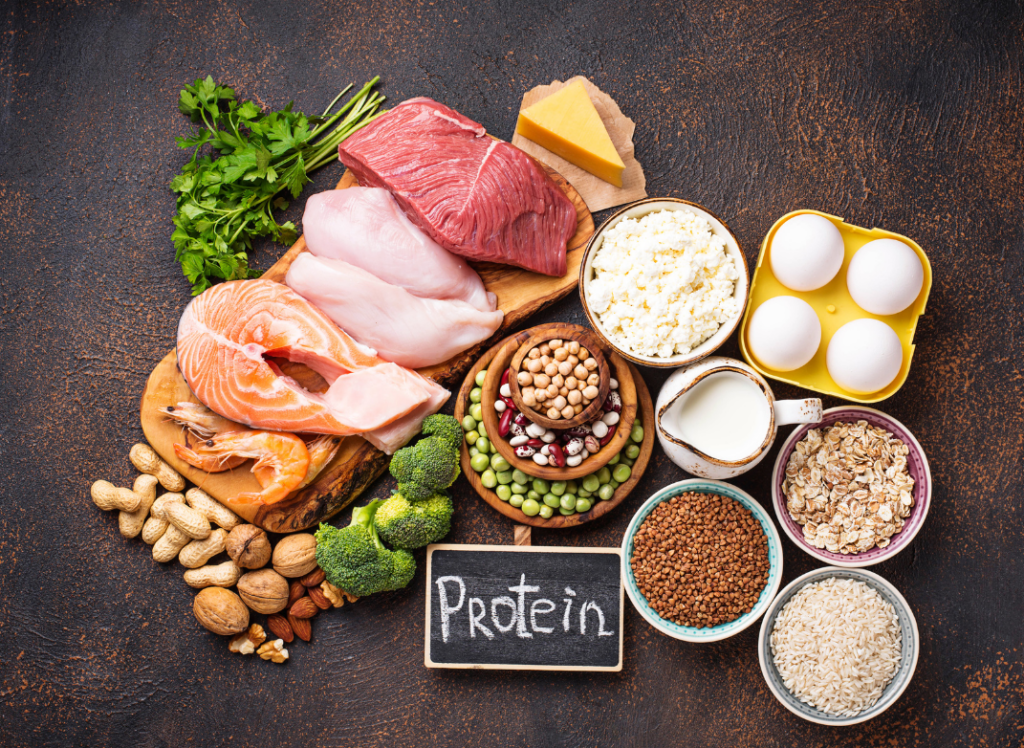
For most women, breakfast is where the gap lives. Eggs, Greek yogurt, cottage cheese, a shake when the morning is going sideways. Nothing exotic, no overhaul required.
Getting There Without the Calories Piling Up
Protein tends to fill you up and keep you there. Researchers pooled 49 short-term trials and mostly found the same thing: less hunger, more fullness, and you can watch it happen in the hormones that switch appetite on and off.
Mostly is doing real work in that sentence. This is one of the more argued-over corners of nutrition. Some trials find no difference. Others find that people who report feeling fuller go on to eat the same amount anyway. A six-month trial that raised older adults to 1.2 grams per kilogram a day found no appetite change at all. Protein is one of several things on your plate doing this job, and it isn’t doing it alone.
Swapping still works better than adding. The Greek yogurt takes the place of the toast rather than joining it, and you land at roughly the same calories with more staying power. Eggs do the same job, and they’re satisfying enough that you’ll eat them again on Thursday, which is the only thing that ever really matters.
If You Don’t Eat Meat
Here the honest answer is more complicated. Plant proteins are generally lower in digestibility and lower in leucine, the amino acid that triggers muscle protein synthesis, and many run short on lysine or methionine. Reviews suggest older adults eating plant-based may need at least 30 percent more protein per meal to get the same response as omnivores.
No reason to abandon a diet you chose on purpose. Longer-term training studies show comparable gains in muscle and strength on plant-based and animal-based diets once total intake, per-meal amounts, and calories are adequate. Combining sources helps, because legumes and grains cover each other’s gaps. And the largest midlife-specific evidence we have, nearly 49,000 women in the Nurses’ Health Study followed for decades, found that protein intake in midlife, plant protein especially, was associated with better odds of aging well.
The work is real and doable. It means bigger portions and more deliberate pairing.
Two Things You Can Do This Week
Take your weight in pounds, divide by 2.2, then multiply by 1.0. That’s your floor in grams. Look hard at breakfast, because that’s almost always where the day starts short.
The second one is what I’d bet money on. Ask a friend or two to text you her favorite protein-forward breakfast every Monday for a month, and send yours back. Trade the recipes that don’t taste like homework. A standing habit holds better when someone else is in it with you, which has been true in every program I’ve built.
It’s a Lot to “Digest“
All of this can feel a bit overwhelming, and it is a lot to digest. Pun intended, and I’m not sorry about it.
If you want to untangle what it means for you specifically, with your body, your bloodwork, your history, and everything else you’re going on with you, a registered dietitian is the person trained to do exactly that. I can point you to what the research says and where it stops.
Someone who studied this for a living can tell you what to do with it.

LAYLO wellness centers social wellness—supported by mental clarity and movement—to help you live and work with more steadiness, connection, and longevity.
The LAYLO Edit is where I share thoughtful, practical insight for real life.
Join for updates on upcoming experiences, Wellness Retreats.
Follow along on Instagram, Facebook, YouTube, LinkedIn, and Pinterest.


