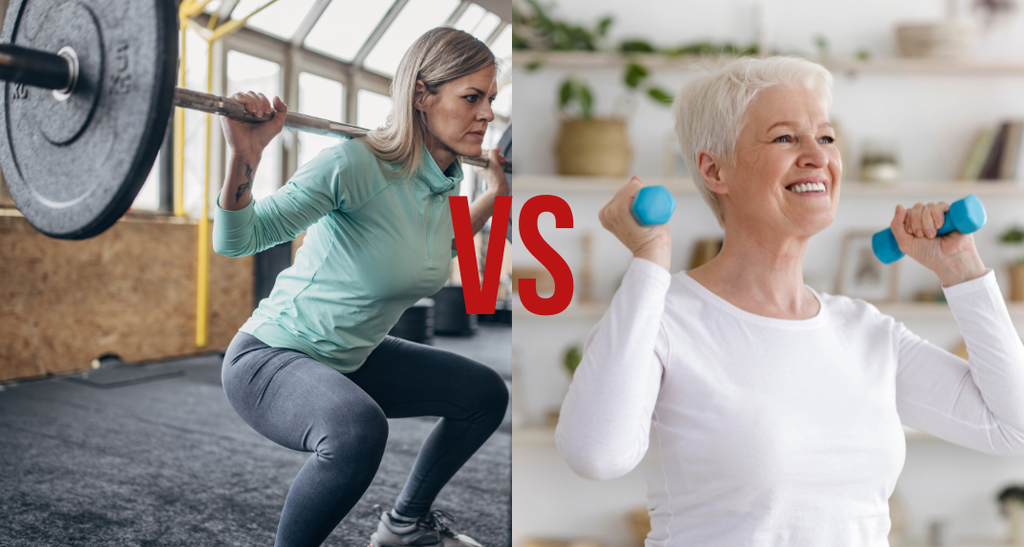
I went looking for a photo to run with this piece. Something simple: a woman around my age, lifting something with intent.
What turned up, over and over, was a smiling, silver-haired woman holding a pair of tiny one-pound dumbbells like it was the best she could do.
Scroll far enough and you’ll see that same shot a hundred times over. Finding an image of a mature woman actually loading a barbell or gripping a heavy kettlebell took real digging.
That stock-photo problem tells you everything about a belief many people have absorbed without noticing. Somewhere along the line, women over fifty got sorted into a category where light and gentle is the default and heavy belongs to somebody else.
The 1-pound dumbbell became shorthand for what we’re apparently allowed to do with our own muscles. The belief is doing real damage to the body it claims to protect.
What Lifting Actually Does for the Heart
When cardiologist Martha Gulati and her colleagues analyzed exercise data from roughly 400,000 adults, published in the Journal of the American College of Cardiology in 2024, the strength-training results stood out for women.
Women who strength-trained two to three times a week were associated with about a 30% lower risk of dying from cardiovascular disease. The same research came with a sobering companion figure: only about one in five women strength-train regularly.
Set those two numbers side by side, and the shape of the problem appears. One of the most protective habits available to a woman’s heart is also one of the least practiced, and the baby dumbbell story is a big part of why.
The Three Dimensions Most Women Never Hear About
Strength training gets talked about as one activity, which is part of what makes it feel more intimidating than it is. It’s really three related capacities, and each one earns its keep at this stage of life.
Muscular endurance is your ability to keep doing something demanding for a stretch of time. Think carrying luggage through a sprawling airport or hauling bags of mulch across the yard until the job is finished. Stamina in the muscles rather than just the lungs.
Muscular strength is raw capacity, and it grows more valuable with every passing decade. We lose muscle as we age, steadily and insidiously, unless we give the body a reason to hold on. Lifting with enough resistance to feel genuinely challenged tells the body to keep the muscle it has and, at any age, to build a little more on top.
Functional strength connects the other two to daily life. Your body twists to reach the seatbelt, bends to lift a grandchild, balances on one leg to pull on a sock. Training those exact patterns keeps you capable in the ordinary movements that determine how independent you stay later on.
Why Strength Says So Much About How You Age
A 2026 study in JAMA Network Open, following women into their later decades, found that muscle strength was associated with mortality risk independent of aerobic exercise. Your walks and your cardio count, and they do not stand in for what strength provides. Grip and leg strength turn out to be reliable indicators of how the whole body is holding up.
None of this benches your other training. A well-rounded week folds in mobility and flexibility alongside the strength work, so the body stays supple as well as strong. Those two deserve a full conversation of their own another time. For now, keep them on your radar so your focus stays balanced instead of tipping entirely toward the weight rack.
A Baseline You Can Actually Start
The research on strength training for women over 50 keeps circling the same unglamorous baseline: two or three sessions a week, twenty to thirty minutes each, no gym required to begin. You can start at home with a couple of adjustable dumbbells, a set of resistance bands, and your own body weight. Squat down to a chair and stand back up. Hinge at the hips. Press something overhead. Carry a heavy object across the room in each hand. Add a bit of resistance as the movements get easier. The muscle only responds when you keep asking a little more of it.
“Heavy,” is relative to you. It means the last couple of repetitions feel like work. A weight that challenges you at fifty-five is the right weight, whatever the number stamped on it. It will almost always be more than one little pound, however! That might be a place to start; it is not the place to stay.
One thing keeps this habit alive better than willpower ever could, and that’s another person. A standing workout date with a friend converts a good intention into a plan with a time attached. Skipping gets a lot harder when someone is meeting you for it. The company keeps you consistent, and consistency is the thing the research actually rewards.
Two or three days a week. Enough resistance to feel it. Someone alongside you when you can arrange it. That’s close to the entire prescription, and your heart has been waiting on it for a while.

LAYLO wellness centers social wellness—supported by mental clarity and movement—to help you live and work with more steadiness, connection, and longevity.
The LAYLO Editis where I share thoughtful, practical insight for real life.
Join for updates on upcoming experiences, including The LAYLO Collective, a small-group social wellness experience designed for real life, and Wellness Retreats.
Follow along on Instagram, Facebook, YouTube, LinkedIn, and Pinterest.