

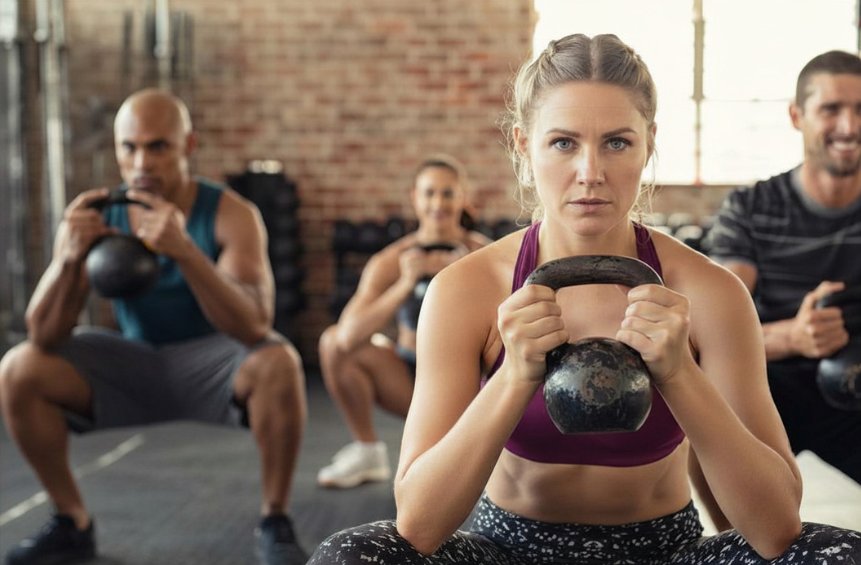
In 2026, the American College of Sports Medicine released an updated position stand on resistance training.
The ACSM does not update its position often, and when it does, the fitness field pays attention.
The headline finding was not about load, volume, or the optimal rep range. It was this: long-term adherence matters more than the specific details of any program.
The ACSM had long emphasized precise programming parameters. This update shifted the ground. Consistency over complexity, stated formally, by the most credentialed organization in fitness science.
For someone like me, who has spent three decades watching how real women train and what actually produces results over time, this landed less as a revelation and more as a long-overdue acknowledgment.
Those Step class years
Back in the 90s, I was the step class queen! Group fitness meant cardio. Layered choreography, loud music, and everyone moving through an hour of elevated heart rate.
Strength training belonged on the gym floor with the machines. It was not what you came to a group fitness class to do.
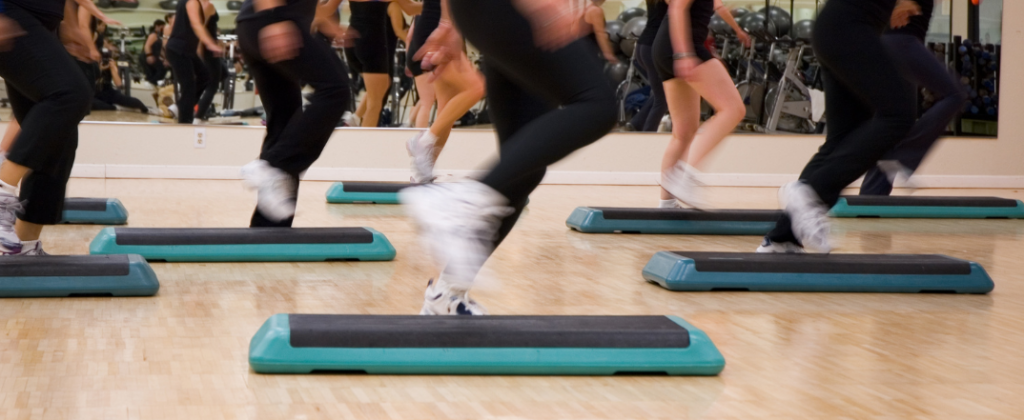
Except in my class. At the end of every session, I had my class spend 15 minutes on strength and balance work. Dumbbells. Squats and lunges. Single-leg holds. Basic compound movements. Nobody came to class for that part.
There was also a widespread belief at the time — completely unfounded — that lifting dumbbells in a group fitness class would make women bulky. That myth was everywhere in the early 90s, and it did not matter that the weights were lighter, the movements were functional, and our testosterone was not up to the job of building big muscles. The cultural story had taken hold.
They did it anyway.
Over the years, people would find me before or after class to share moments where that training showed up in their actual lives. Not in a gym. Out in the world. Someone caught herself before a fall on an icy sidewalk. Another got up off the ground after a stumble without needing help. Someone carried moving boxes up a flight of stairs at 55 and felt none of the strain she expected. These were not performance stories. They were life stories. Training for your life, not training for the sake of training.
The ACSM caught up in 2026. The science was always pointing this direction.
What the research adds
The ACSM guidelines establish the framework. The outcome research fills in what is at stake.
Women who strength-train two to three times a week have a 30 percent lower risk of cardiovascular mortality. That comes from a 2024 study in the Journal of the American College of Cardiology that tracked more than 400,000 participants. One in five women currently meets this threshold.
A 2026 study in JAMA Network Open found that muscle strength predicts mortality in older women independent of aerobic exercise. Strength training carries its own protective effect that cardio alone does not replicate.
A 15-year Australian study published in PLOS Medicine in 2026 followed more than 11,000 women. Those who consistently met exercise guidelines in their 50s and 60s were roughly half as likely to die early. The operative word across all of this research is consistently. The result does not come from periodic intensity. It comes from showing up over time.
On balance specifically: fall-related injuries are among the leading causes of serious health decline and loss of independence in older adults. Training for balance now costs a few minutes per session. The ACSM includes gait speed and balance among the functional targets for healthy adults over 65 for exactly this reason.
The menopause layer
Declining estrogen reduces muscle protein synthesis, shifts fat storage toward the abdomen, and slows recovery. Strength training addresses body composition, bone density, metabolic function, and mood simultaneously. A randomized controlled trial found that strength training reduced hot flashes in some women, alongside improving bone density and metabolic markers.
Current research recommends 1.0 to 1.2 grams of protein per kilogram of body weight per day for healthy older adults, distributed across meals to support muscle retention and recovery. The training and the nutrition work together.
The ACSM’s emphasis on functional outcomes maps directly onto what happens to women’s bodies in this decade. Training for gait speed and balance is training for the ability to stay active, stay independent, and stay in your own life on your own terms.
What this means for you
It’s straightforward: two to three strength sessions a week, 30 to 45 minutes each. Compound movements that work multiple muscle groups at once — squats, deadlifts, rows, presses. Ten minutes of balance work folded in. You do not need a trainer five days a week or a complicated program to track. You need dedicated time on your calendar.
Start where you are. If two sessions a week is new, that is the goal. Build from there. Progressive load means asking a little more of your body over time as it adapts, not pushing to failure every session. The ACSM is explicit on this: training to failure is not required for results.
You do not have to do this alone. Research shows that the people in your circle shape your habits, for better or worse. A training partner, a small group class, or a community where movement is part of the culture changes the math on consistency. Showing up is easier when someone is expecting you. The social piece is not a bonus feature of exercise. For many women, it is the reason the habit holds at all.
What you build now compounds over the next decade. Stronger muscles protect your joints and your heart. Better balance keeps you on your feet. Maintained mobility keeps you independent. None of this requires perfection. It requires showing up on a regular Tuesday, even when the motivation is not there, even when 30 minutes is all you have.
The longer view
The women who kept going outlasted the ones who went harder. This was true in 1993 and the research confirms it now.
A program someone follows consistently for two years produces more than an optimized program abandoned after a season. The ACSM formalized this in 2026. The outcome data on women over 50 says the same thing in numbers.
Two to three sessions a week. Compound movements. Balance work included. No requirement for a full gym, a complicated program, or training to failure. The updated ACSM guidelines confirm all of it.
Some things are obvious long before the position stands catch up.
Physical wellness at LAYLO wellness connects directly to social and mental wellness because the body does not operate in separate categories. How you move affects how you sleep, how you recover, and how you show up everywhere else.
Start at laylowellness.com.
LAYLO wellness centers social wellness—supported by mental clarity and movement—to help you live and work with more steadiness, connection, and longevity.
The LAYLO Editis where I share thoughtful, practical insight for real life.
Join for updates on upcoming experiences, including The LAYLO Collective, a small-group social wellness experience designed for real life, and Wellness Retreats.
Follow along on Instagram, Facebook, YouTube, LinkedIn, and Pinterest.


