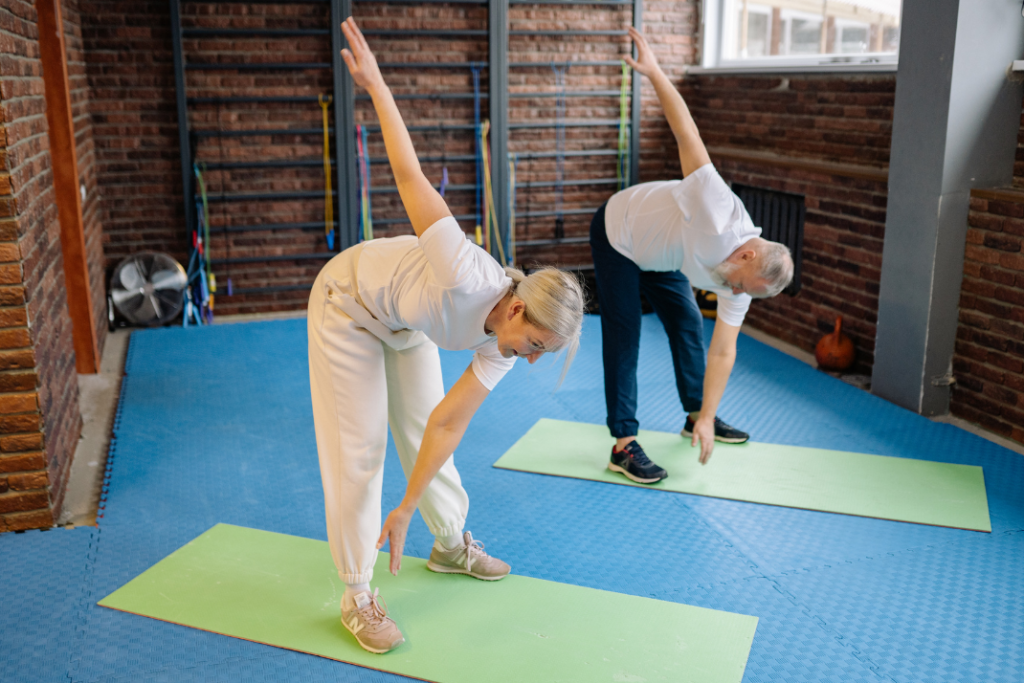
Mobility goes gradually, in increments small enough that you can talk yourself out of noticing.
You reach for the pan at the back of the cabinet, decide it isn’t worth the stretch, and take the one in front.
Getting down on the floor with the grandkids drops off the list because standing back up got awkward.
The escalator starts winning out over the stairs.
Each of these is a reasonable little choice on its own, and you make the next adjustment without ever noticing you made the last. By the time it registers, you’re working around a body that does less than it did a couple of years ago.
After 50, the range you keep is the range you protect on purpose. Movement is what keeps you independent: capable of getting yourself off the ground, out of a low chair, into the back seat to buckle a car seat. Two things make that possible, and people mix them up constantly.
Mobility and Flexibility Do Two Different Jobs
Mobility is how far a joint can move under its own power. Picture your shoulder rolling through a full circle, your hip opening to let you squat down to a bottom shelf, your spine rotating so you can check your blind spot without turning your whole torso.
Flexibility is the ability of the muscles and tendons around that joint to lengthen and allow the movement to happen.
One describes the joint’s available range. The other describes the tissue’s willingness to permit it. You want both, and they feed each other. Tight hamstrings limit how deep your hips can hinge. Stiff hips push your lower back into work it was never built for. Flexibility matters, and you need to be tending to it. Mobility is where the daily payoff shows up, so you cannot ignore the effort needed to keep that range of motion alive.
Move Every Joint Through Its Range Every Day
You don’t need a mat, an app, or forty minutes. Every morning, take each major joint through slow circles. Roll your ankles and wrists. Circle your shoulders, then your whole arms. Rotate your spine gently from side to side. Draw a few slow knee-to-chest pulls to open and close your hips. Five minutes covers it. Joints that move daily stay accustomed to moving, and the ones you never take through a full range gradually forget they had one.
Get Down to the Floor and Back Up
The ability to lower yourself to the ground and stand again with control tracks closely with staying independent as you age. Practice it on purpose. Sit down on the floor, get comfortable, then rise back up using as little help from your hands as you can manage. A few times a week is plenty. This trains your hips, knees, and ankles together in the exact pattern real life keeps asking for, whether you’re gardening, reaching a low outlet, or getting up after an hour on the floor with a two-year-old.
Stretch What the Day Tightens
This is your flexibility work, and it is more important than you might realize. Sitting shortens your hip flexors. Phones, keyboards, and steering wheels round your shoulders forward and tighten your chest.
A few targeted stretches, held for about 20+ seconds or 3 slow breaths, walk all of that back. Open your chest in a doorway. Lengthen your hip flexors with a gentle kneeling stretch. Give your hamstrings some slow, unforced attention. Thirty to sixty seconds each, most days of the week. Consistency does far more here than intensity ever could.
Build Strength Through the Whole Range
Range you can’t control won’t hold up when you need it. A hip that opens wide but collapses under load will still let you down when you reach for something heavy on a high shelf. Add gentle strength at the ends of your range. Squat down to a chair and stand back up, slow and controlled. Press a light weight overhead with your arm fully extended. Carry the groceries in one trip instead of two. Strength through a full range is what makes your mobility usable when it actually counts. I spent years adding this kind of work to the end of high-energy cardio classes before the industry had a name for it, because cardio alone was leaving people strong in the middle of their range and fragile at the edges.
Respect the Flare and Scale Back
Moving matters. Protecting an irritated joint matters every bit as much, and sometimes protecting it means backing off. Aging comes for all of us, and it never checks whether the timing is convenient. I have a bulging disc in my lower back, and every so often it flares. When it does, the smart play is to be gentle with it, scale back to what my body can handle that week, and rebuild once things settle. This is the part people get wrong. They either quit entirely at the first twinge or tough their way through and make the whole thing worse.
The people who keep their range for decades do the unglamorous middle thing. They keep moving within their limits, they respect the flare-ups, and they come back. Old injuries, cranky joints, and the general wear of a well-used body are going to show up eventually.
Whether a challenge costs you a rough week or a rough year depends largely on the work you put in before it arrived. Skip the maintenance and the flares hit harder, arrive more often, and take longer to recover from. Keep the maintenance and your body has something solid to fall back on.
The Reason This Habit Actually Sticks
The morning circles, the floor practice, the walks all hold better when someone else is in it with you. There’s real evidence behind that instinct. Research following roughly thirteen thousand adults over 50 for eight years found that people with high-quality friendships were associated with noticeably more exercise, about 9% more, than those without them. A standing walk with a friend turns a good intention into a plan you actually keep. Your knees benefit, and so does the rest of you. Even an accountability check-in over text keeps both the habit and the friendship going.
None of this requires a gym membership or a personality transplant. Five minutes of circles, a little honest floor time, some patient stretching, strength you can control, and the good sense to ease off when your body asks for it. If you want to dig deeper, go to a professional (not YouTube!) to get some tips on how to increase your mobility safely and effectively for your body.
Do the small things now, on the ordinary days, and your future self gets to keep reaching the top shelf, sitting on the floor, and buckling the car seat without a second thought. That’s what this protects. Your ordinary, capable, independent life.

LAYLO wellness centers social wellness—supported by mental clarity and movement—to help you live and work with more steadiness, connection, and longevity.
The LAYLO Editis where I share thoughtful, practical insight for real life.
Join for updates on upcoming experiences, including The LAYLO Collective, a small-group social wellness experience designed for real life, and Wellness Retreats.
Follow along on Instagram, Facebook, YouTube, LinkedIn, and Pinterest.